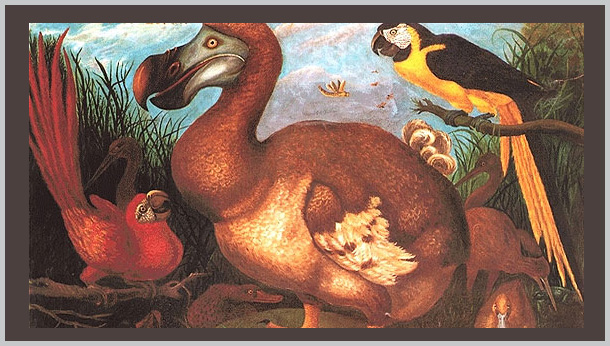
Dodo Bird
Name: Dodo Bird (Raphus cucullatus)
Conservation Status: Extinct
The dodo bird inhabited the island of Mauritius in the Indian Ocean, where it lived undisturbed for so long that it lost its need and ability to fly. It lived and nested on the ground and ate fruits that had fallen from trees. There were no mammals on the island and a high diversity of bird species lived in the dense forests.
In 1505, the Portuguese became the first humans to set foot on Mauritius. The island quickly became a stopover for ships engaged in the spice trade. Weighing up to 50 pounds, the dodo bird was a welcome source of fresh meat for the sailors. Large numbers of dodo birds were killed for food.
Later, when the Dutch used the island as a penal colony, pigs and monkeys were brought to the island along with the convicts. Many of the ships that came to Mauritius also had uninvited rats aboard, some of which escaped onto the island.
Before humans and other mammals arrived the dodo bird had little to fear from predators. The rats, pigs and monkeys made short work of vulnerable dodo bird eggs in the ground nests.
The combination of human exploitation and introduced species significantly reduced dodo bird populations. Within 100 years of the arrival of humans on Mauritius, the once abundant dodo bird was a rare bird.
The last dodo bird was killed in 1681.
Although the tale of the dodo bird’s demise is well documented, no complete specimens of the bird were preserved; there are only fragments and sketches. The dodo bird is just one of the bird species driven to extinction on Mauritius. Many others were lost in the 19th century when the dense Mauritian forests were converted into tea and sugar plantations.
Of the 45 bird species originally found on Mauritius, only 21 have managed to survive.
Although the dodo bird became extinct in 1681, its story is not over. We are just beginning to understand the effects of its extinction on the ecosystem.
Recently a scientist noticed that a certain species of tree was becoming quite rare on Mauritius. In fact, he noticed that all 13 of the remaining trees of this species were about 300 years old. No new trees had germinated since the late 1600s.
Since the average life span of this tree was about 300 years, the last members of the species were extremely old. They would soon die, and the species would be extinct. Was it just a coincidence that the tree had stopped reproducing 300 years ago and that the dodo bird had become extinct 300 years ago? No.
It turns out that the dodo bird ate the fruit of this tree, and it was only by passing through the dodo’s digestive system that the seeds became active and could grow. Now, more than 300 years after one species became extinct, another was to follow as a direct consequence. Will more follow?
Luckily, some creative people discovered that domestic turkey gullets sufficiently mimic the action of the dodo bird’s digestive system. They have used turkeys to begin a new generation of the tree, which is now called the dodo tree. If these seedlings survive to produce their own seeds, the species will be saved.
Questions for Thought:
Mauritius is a medium-sized island that is extremely far away from any mainland. What does Island biogeography suggest about such places?
Birds and bats are frequently responsible for the natural pollination and seed dispersal of trees. What will their extinctions and endangerment mean for the forests where they live?
Related Classroom Activities:
[CS2-8,C3-1,C3-2, General]